S01E01 - Tor

The very first scene of Mr. Robot opens in a coffee shop called Ron’s. Elliot sits across from the owner and calmly lays out everything he knows. No action, no chase. Just two people at a table, and one of them knows everything.
The line that sets the tone for the entire show:
“The onion routing protocol, it’s not as anonymous as you think it is. Whoever’s in control of the exit nodes is also in control of the traffic, which makes me… the one in control.”
Then the FBI walks in.
So, is he right?
TL;DR
| 🎬 Reel or Real? | ⚠️ Real for clearnet sites, not how hidden services work. 🎲 Low probability either way. |
What Is Tor
Tor (The Onion Router) routes your internet traffic through a chain of three volunteer-operated relays before it reaches its destination. Each relay only knows the previous and the next hop. No single node knows both who you are and where you are going. Traffic is encrypted in layers. Each relay peels one.
That’s the theory. In practice, the exit node is where it breaks down.
What Is an Exit Node
Exit nodes sit at the end of the chain. It’s the one that connects to the destination server on your behalf. By this point, all the encryption layers have been peeled. From there, the exit node sees the destination and, if the site uses plain HTTP, the full content of the traffic.
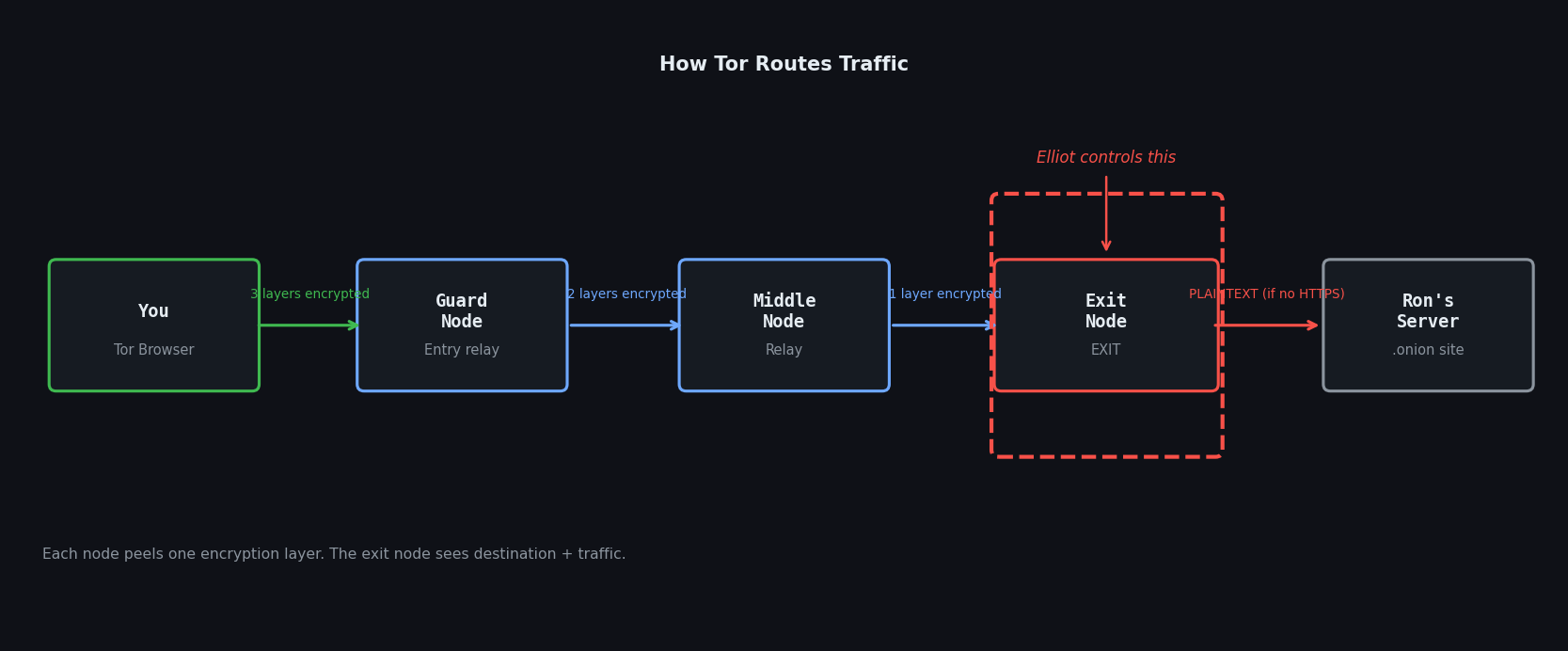
Your identity stays hidden. The exit node doesn’t know who you are. Your real IP is hidden behind the guard and middle nodes. But it does see where you are going and what you are sending. That’s the trade-off built into how Tor works.
Is Elliot’s Claim True
Partially, and it depends on what you mean by “in control.”
What exit node operators can see:
- The destination IP or domain
- Unencrypted HTTP traffic (content, passwords, cookies)
- Timing and volume of traffic
What they can’t see:
- The Tor user’s real IP address
- The Tor user’s identity (without additional correlation)
So running an exit node doesn’t give you full surveillance of Tor users. But it does give you a privileged view of outgoing traffic, especially when the destination doesn’t use HTTPS.
But the show contradicts itself. Elliot describes Ron’s site as a hidden service, a server reachable only through the Tor network. Hidden services don’t use exit nodes. Traffic to a .onion address never leaves Tor. Both sides meet at a rendezvous point inside the network, encrypted end to end. No exit node is involved.
So the exit node claim doesn’t apply to the scenario the show sets up. If Ron were running a regular website and users accessed it through Tor, then yes, an exit node operator could see the traffic. For a hidden service, that path doesn’t exist.
Each piece is right on its own (exit nodes, hidden services, traffic monitoring) but mixed them in a way that breaks the model. Good television, sloppy networking.
What It Takes, and Why the Odds Matter
Becoming an exit node isn’t instant. A relay needs to run continuously for around 7 days to earn the Stable flag, build enough throughput to earn the Fast flag, and explicitly opt in with ExitRelay 1. Directory Authorities then assign the Exit flag based on observed performance. New relays start with near-zero traffic weight and ramp up over weeks.
Here’s the bigger problem: Tor selects relays weighted by bandwidth. If Elliot’s exit node contributes a few hundred megabits and the total Tor exit capacity is hundreds of gigabits, his node handles a fraction of a percent of all exit traffic. The probability that any specific user’s connection routes through his node is very low.
For his hack to work, he would need either a lot of exit nodes running for a long time, or something else to have gone right first: an operational security mistake on Ron’s end, a vulnerability in the hidden service software, or prior knowledge that narrowed down the traffic he needed to watch.
All of this gets compressed into one line. Concept? Real. Probability? Not even close.
Closing
Did Elliot get lucky, or did Ron’s opsec fail? The show doesn’t say, and that ambiguity is probably the point. Real attacks rarely come down to one clean technique. It’s patience, positioning, and waiting for someone to slip.
A probability problem got squeezed into a single line of dialogue. That’s entertainment. The concept is real. The odds? Not so much.
Next: S01E01 - Password Cracking.